Milivoj Berberović
Biographical card of Milivoj Berberović (Michele Berberovich), teacher in Trieste.
The Captain's son who wanted to be a teacher
A life on land, from Morinj to Trieste
Milivoj Berberović was born in Morinj (Boka Kotorska) on 10 August 1861, the son of Captain Krsto Markov Berberović and Kata Tomanović. Whereas navigation records report that some of his brothers and his sister were born at sea—an unusual arrangement for the time, as Captain Krsto’s wife was living on the ship with her husband—Milivoj was born on land — and perhaps this marked his destiny.
In fact, the first Berberović in many generations, Milivoj did not study to become a ship captain, nor did he enter the seminary to become a prota. When Milivoj turned fourteen, he was sent to study at the I.R. Scuola Magistrale in Borgo Erizzo, Zara (Zadar), the newly established teachers’ training school. He attended the institution for three years and graduated as a teacher in July 1878.
According to his diploma, preserved in the family archive, Milivoj received a scholarship of 400 fiorini during his studies. As a consequence, he incurred the obligation to serve for six years as a teacher in a public school in any of the provinces represented in the Consiglio dell’Impero.
After completing his studies, Milivoj returned to Morinj, where he began teaching at the local elementary school.
La I.R. Scuola Magistrale di Borgo Erizzo (1875-1878)
Forced Slavisation and the Question of Education in Dalmatia
The question of the forced Slavisation of Dalmatia is particularly important for this story, as it would later be mirrored—often with equal violence—by the forced Italianisation policies implemented by Italy after the dissolution of the Austro-Hungarian Empire.
The I.R. Scuola Magistrale di Borgo Erizzo played a key role in this context. Founded in 1868, it was established in Zara in the former building of the Lazzaretto, which was restructured for this purpose. It was the only teacher-training school in all of Dalmatia, and it was created by direct order of Emperor Franz Joseph, with a very specific purpose in mind.
Continue reading →
Crown Council of 12 November 1866
This earlier phase is discussed in detail by Marco Vigna in his article “L’agonia della Dalmazia italiana sotto Francesco Giuseppe”, published in Nuovo Monitore Napoletano on 20 October 2013. Drawing on a wide range of historical sources, Vigna documents how, after 1866, the imperial authorities deliberately pursued a policy aimed at the de-Italianisation of Dalmatia through Germanisation and Slavisation.
«Sua Maestà ha espresso il preciso ordine che si agisca in modo deciso contro l’influenza degli elementi italiani ancora presenti in alcune regioni della Corona […] per la germanizzazione e la slavizzazione di detti territori, con energia e senza riguardo alcuno.»
As Vigna notes, this imperial directive—issued during the Crown Council of 12 November 1866— is well known among historians but largely absent from popular narratives, contributing to the persistence of what Claudio Magris calls “Habsburg myth."
The role of education
Education played a central role in this policy. The systematic removal of Italian-language instruction from schools, combined with the refusal to fund surviving Italian institutions, rapidly dismantled a cultural landscape that had long been bilingual and multi-ethnic. By the end of the nineteenth century, Italian primary schools remained only in Zara, while Italian secondary education survived exclusively in the nautical schools of Ragusa and Cattaro—exceptions tolerated for practical reasons linked to maritime tradition.
It is against this background that the experience of students educated in institutions such as the I. R. Scuola Magistrale di Borgo Erizzo must be understood. One may therefore wonder how this influenced young Milivoj Berberović in the years 1875–1878, when he attended the Preparandio (a contemporary term used in Zara to refer to the teachers’ training school). The final grades reported on Milivoj’s diploma are particularly telling:
| Subject | Grade (Italian) | Grade (Croatian) |
|---|---|---|
| Religione | Molto buono | Vrlo dobro |
| Lingua italiana | Sufficiente | Dovoljno |
| Lingua serbo-croata | Buono | Dobro |
| Lingua tedesca | Molto buono | Vrlo dobro |
| ... | ... | ... |
| Fisica | Buono | Dobro |
| ... | ... | ... |
Grades as reported on Milivoj Berberović’s diploma from the I. R. Scuola Magistrale di Borgo Erizzo (1878).
Oscar Randi on Borgo Erizzo
Oscar Randi, an Italian historian and publicist from Zara (1876–1949), wrote extensively on Dalmatia and the Balkans. Active first as a journalist and later within Fascist-era cultural institutions, he offered a sharp reading of the I. R. Scuola Magistrale di Borgo Erizzo in an article published in La Rivista Dalmata in 1940.
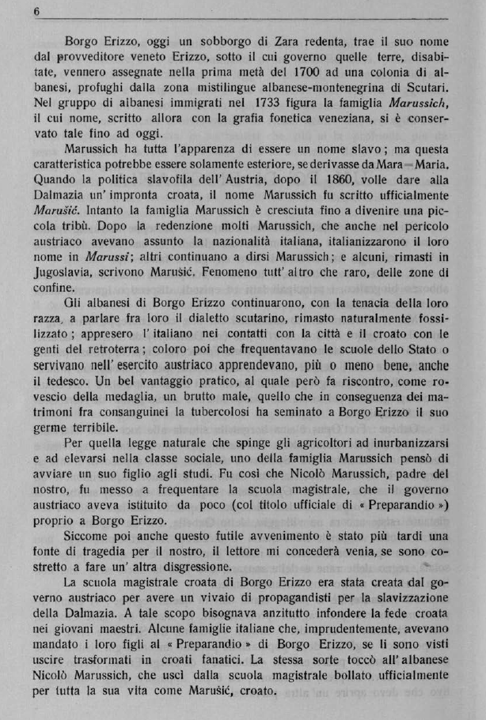
Borgo Erizzo, today a suburb of “redeemed” Zadar (original: Zara redenta), takes its name from the Venetian provveditore Erizzo, under whose administration those lands—then uninhabited—were assigned in the first half of the eighteenth century to a colony of Albanians, refugees from the mixed Albanian–Montenegrin area of Scutari.
The Croatian teachers’ training school of Borgo Erizzo had been created by the Austrian government in order to provide a breeding ground for propagandists for the Slavization of Dalmatia. To this end, it was first necessary to instil Croatian national feeling in the young teachers. Some Italian families who, imprudently, had sent their children to the “Preparandio” of Borgo Erizzo saw them return transformed into fanatical Croats.
Randi’s assessment must be read in light of the political context in which it was written. The article dates from 1940, during the Second World War, at a time when Fascist Italy promoted a strongly irredentist vision of Dalmatia, presenting the region as fundamentally Italian and denying or marginalizing its Slavic identities. Randi himself was a committed supporter of the Fascist regime, and his language reflects this ideological framework.
Source: Marco Vigna, “L’agonia della Dalmazia italiana sotto Francesco Giuseppe,” Nuovo Monitore Napoletano, 20 October 2013. Oscar Randi, article in La Rivista Dalmata, Anno XXI, fasc. I, Zara, 1940. Carlo Federico Cav. Bianchi, "Fasti di Zara Religioso - Politico - Civili dall'anno 1184 Av. Cr. sino all'anno 1888 dell'era volgare." Tipografia di G. Woditzka, Zara, 1888.
A petition to the School Council (1892)
After graduating as a teacher in 1878 from the Scuola Magistrale di Borgo Erizzo in Zadar, Milivoj was obligated to serve in public schools of the Austro-Hungarian Empire for five years. This service requirement was a condition of the 400-florin scholarship he had received during his high school studies. Following his education, Milivoj served as a temporary teacher at the school in Morinj.
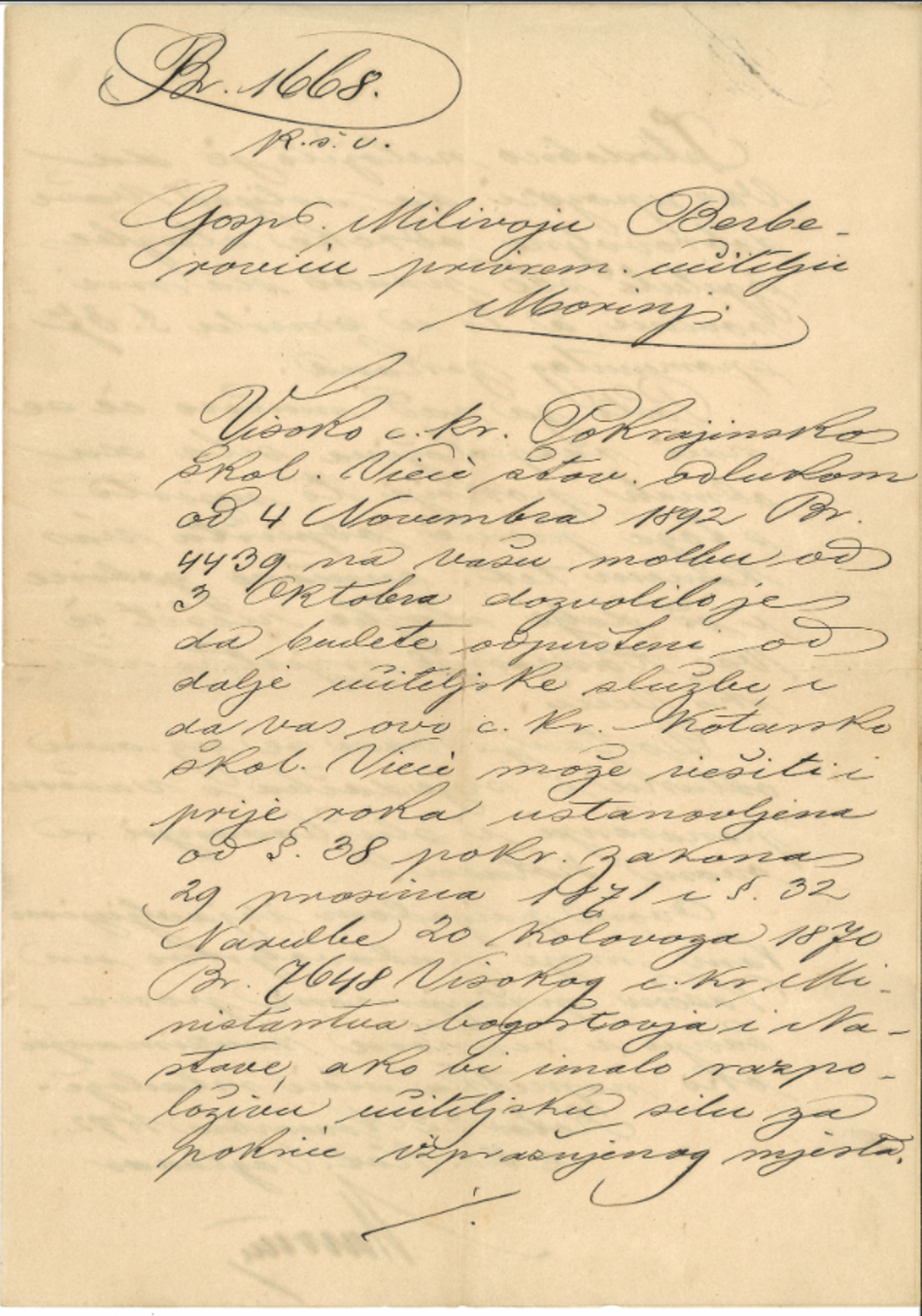
In late 1892, Milivoj petitioned the High Imperial and Royal Provincial School Council to be released from his teaching duties. While family records do not specify the motive for his departure, it coincided with a period of transition for his family; his brother Marko had obtained his ship captain's patent in Trieste in 1890 and was serving as First Officer on the Montenegrin steamship, Yaroslav. Furthermore, his uncle, Captain Peter Berberovic (Pietro Berberovich), had also established his residence in Trieste, providing a strong family connection to the city.
Continue reading →
The Council reviewed his petition on November 4, 1892, and officially granted his release. However, the dismissal carried two significant conditions:
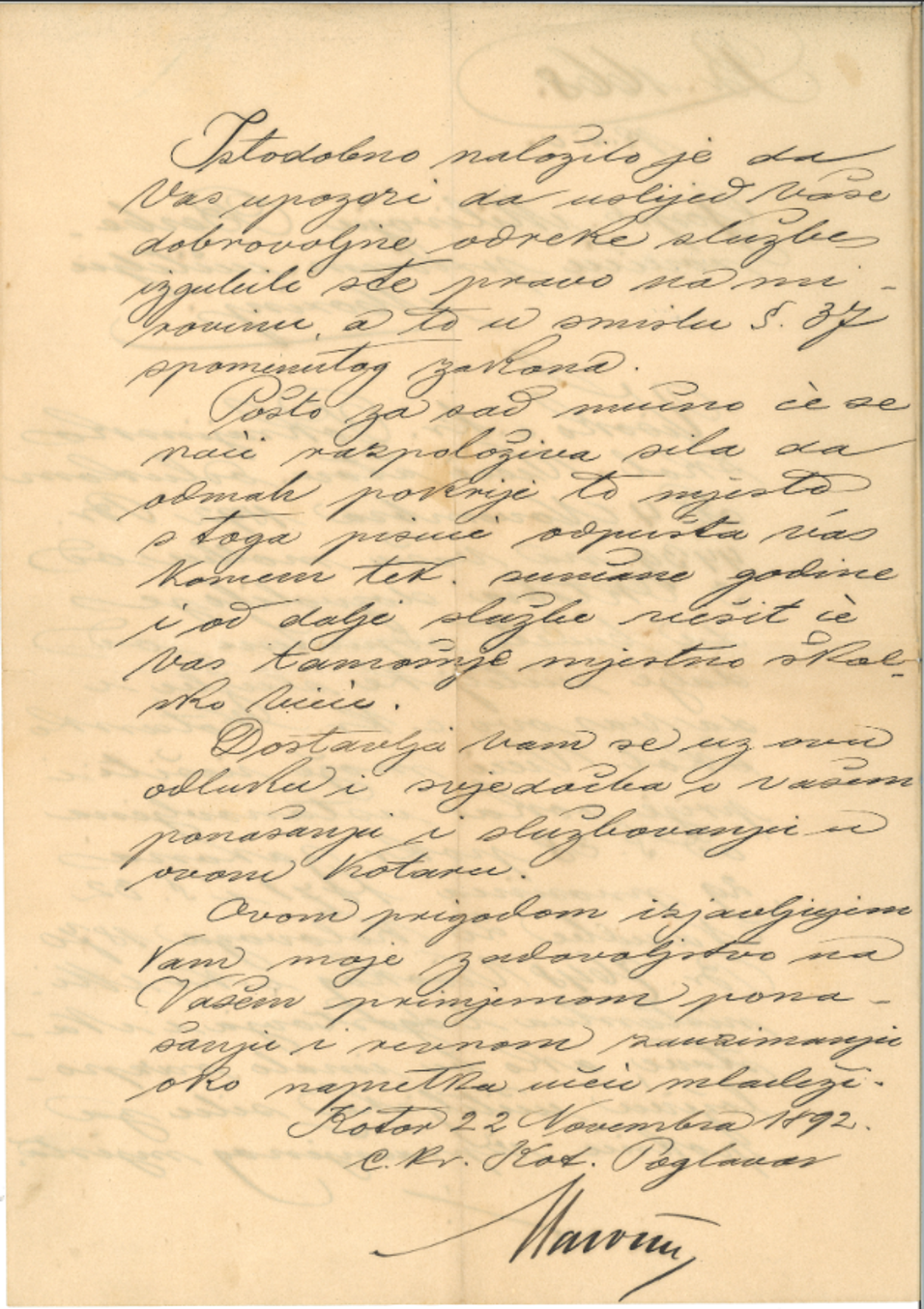
- Pension Forfeiture: Because his resignation was voluntary, he was warned that he would lose all rights to a state pension under the laws of the time.
- Delayed Departure: He was not permitted to leave immediately; due to the difficulty of finding a replacement, he was required to remain in his post until the end of the calendar year.
Despite the bureaucratic hurdles, the Imperial and Royal District Head in Kotor closed the matter on November 22, 1892, by issuing Milivoj a formal certificate of conduct. Shortly after leaving his post in Morinj, Milivoj moved to Trieste, where he had successfully secured a position as a teacher in the local Serbian school.
Below is the actual translation of the original letter:
To Mr. Milivoj Berberović, temporary teacher, Morinj. The High Imperial and Royal Provincial School Council, by its decision of November 4, 1892, No. 4439, regarding your petition of October 3, has granted that you be released from further teaching service. This Imperial and Royal District School Council may discharge you even before the deadline established by law, provided that it has available teaching staff to cover the vacated position. At the same time, it was ordered that you be warned that due to your voluntary resignation from service, you have lost the right to a pension. Since it will be difficult to find available personnel immediately, the undersigned hereby dismisses you at the end of the current calendar year. Attached to this decision is a certificate regarding your conduct and service in this District. On this occasion, I express to you my satisfaction with your exemplary conduct and diligent commitment to the progress of the students.
Life in Trieste
November 1918, the last days in the life of Milivoj
Meet Mr. Galli, he will do something for you
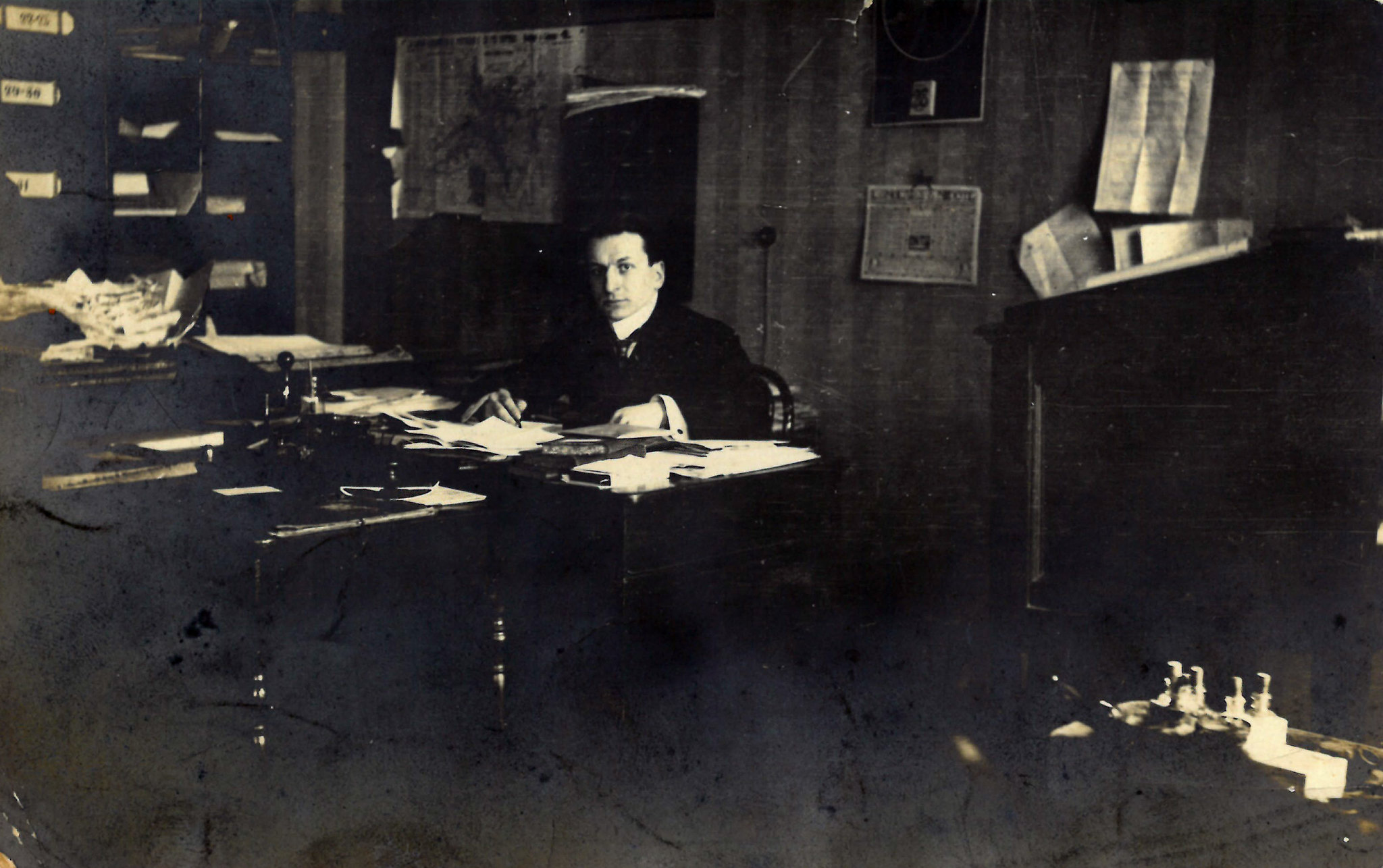
The twenty years old son of Milivoj, Giorgio Berberovich, is mentioned in the book Diarii e Lettere, Tripoli 1911 - Trieste 1918 by Carlo Galli, an italian diplomat who served as vice consul of the Kingdom of Italy, in Trieste, from 1905 and 1911, and who returned to Trieste in 1918, the same day when Italy took control over the city.
It is a surprising, well documented account of the days around Milivoj's death.
Continue reading →
Carlo Galli (1878-1966)
Born in Florence on 25 November 1878, Carlo Galli graduated in law and entered the consular service in 1904. A year later, in 1905, Galli successfully obtained to be appointed as Vice Consul of Italy in Trieste. In 1911, he was sent to Tripoli and returned to Trieste on 4th November 1918. Later, he was promoted to the diplomatic role: between 1924 and 1938, Galli served as ambassador in Teheran, Lisbona, Belgrade and Ankara. However, for divergencies with the Mussolini government, he was sent to retirement in 1938. After 25 July 1943 he returned to public life and was appointed Minister of Popular Culture in the Badoglio government, serving from 15 August 1943 to 24 February 1944. After the events of 8 September 1943 he was arrested by the Nazi-Fascists and interned, first in San Vittore and then in the concentration camp of Lumezzane, where he remained until April 1945. At the end of the war he was freed and returned to Venice, where he retired to private life. Carlo Galli died in Venice on 12 January 1966.
An unexpected visit
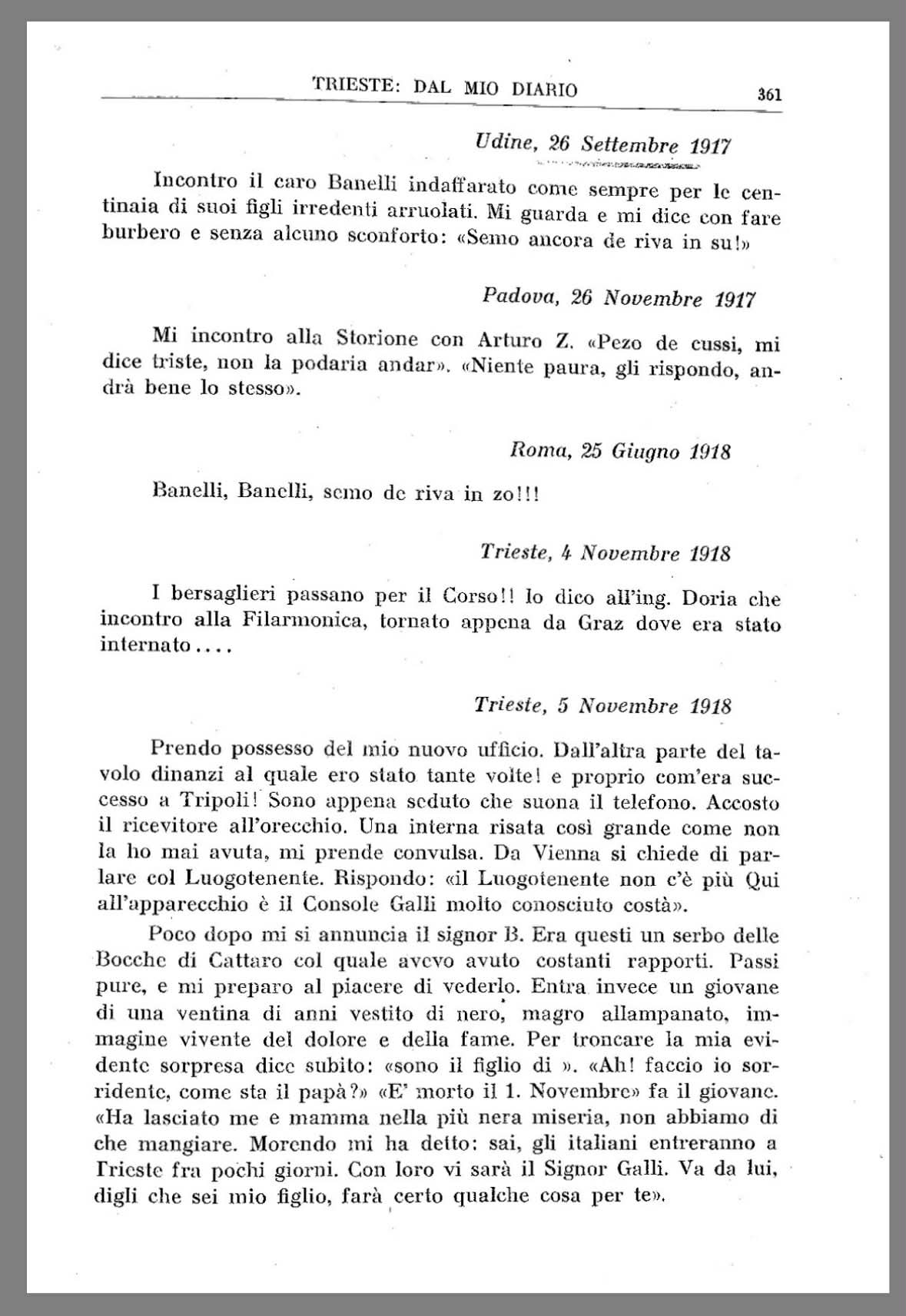
In his book, Galli, refers about his meeting with Giorgio:
Trieste, 8 Novembre 1918
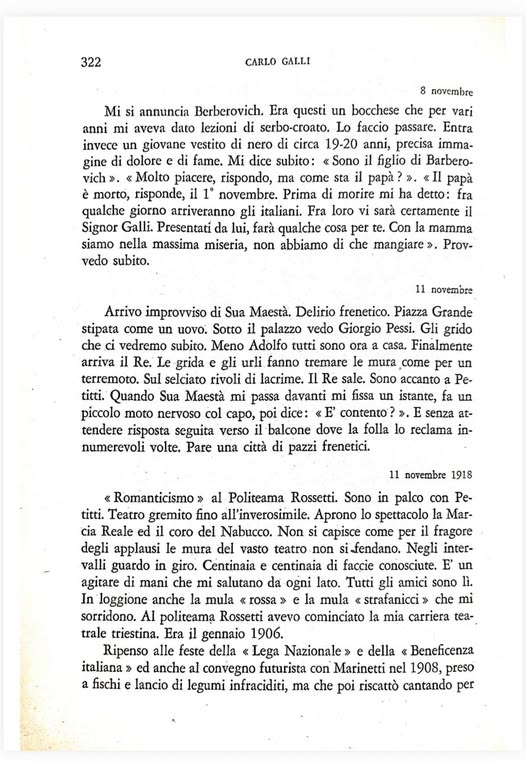
Mi si annuncia Berberovich. Era questi un bocchese che per vari anni mi aveva dato lezioni di serbo-croato. Lo faccio passare. Entra invece un giovane vestito di nero di circa 19-20 anni, precisa immagine di dolore e di fame. Mi dice subito: «Sono il figlio di Berberovich».
«Molto piacere, rispondo, ma come sta il papà?»
«Il papà è morto, risponde, il primo novembre. Prima di morire mi ha detto: fra qualche giorno arriveranno gli italiani. Fra loro vi sarà certamente il Signor Galli. Presentati da lui, farà qualche cosa per te. Con la mamma siamo nella massima miseria, non abbiamo di che mangiare»
Provvedo subito.
Translation in Englis:
Trieste, 8 November 1918
I am told that Berberovich has arrived. He was a man from the Bocche who for several years had given me lessons in Serbo-Croatian. I have him shown in. Instead, a young man dressed in black enters, about nineteen or twenty years old, a vivid image of sorrow and hunger. He immediately says: “I am the son of Barberovich.”
“Very pleased,” I reply, “but how is your father?”
“My father is dead,” he answers, “on the 1st of November. Before dying he told me: in a few days the Italians will arrive. Among them there will certainly be Mr. Galli. Introduce yourself to him, he will do something for you. My mother and I are in the greatest misery; we have nothing to eat.”
In his diary, Galli noted: I took care of this, immediately.
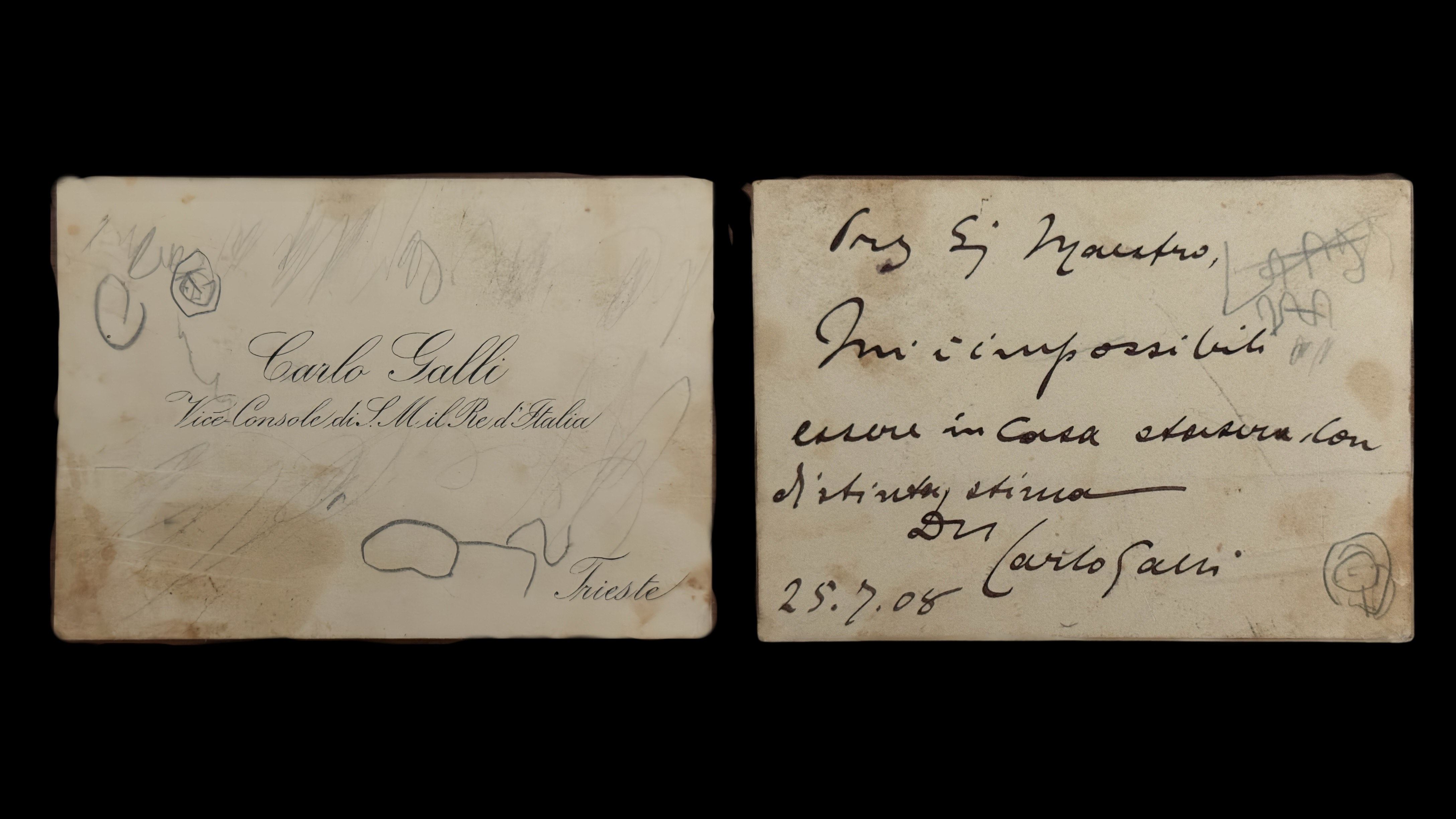
In the archive documents of the Berberovic family, which I have inherited, it was preserved a visiting card of Carlo Galli, Vice Console di Sua Maestà il Re d'Italia, which on the back has a handwritten note saying “Dear maestro, I will not be able to be at home tonight. My honourable regards, Carlo Galli”, and a date “25 July 1908”.
The autographed visiting card confirms that Milivoj Berberović had been giving private lectures in serbo croatian to Carlo Galli. It also offers a verification on the episode reported in Galli's memories and it confirms that the young men showing at Galli's office was in fact Milivoj's son Giorgio Berberovich
La Porta Orientale
A slightly different version of this episode appears in an early publication of the diaries of Carlo Galli—at the time Ambassador in Ankara—published in the magazine La Porta Orientale, September–December 1938, Anno VIII, Fasc. 9–12. A copy of this issue is preserved at the University of Trieste.
The extracts reproduced here are taken from Galli’s diary and offer a vivid picture of the social and political atmosphere in Trieste during the days of transition from Austro-Hungarian rule to Italian sovereignty. It is noteworthy that the visit of Giorgio Berberovich appears in this context, not as an isolated anecdote, but as emblematic of an entire era and of the broader shift in power and dominant culture. Trieste was no longer a multilingual, multi-identitarian society oriented toward the Adriatic routes; it had become a provincial city within a kingdom in which Trieste retained a strong symbolic meaning, but little cultural, economic, or societal centrality.
Here the date of the meeting with Giorgio is set on November 5, 1918.
L’Impero è morto, viva il Re!
The next annotation by Galli shows a stark contrast between the misery of this once wealthy and respected family in Austro-Hungarian Trieste and the newly established Italian rule. On 11 November, King Vittorio Emanuele III of Italy arrives in Trieste, and the main square — then still called Piazza Grande, and later renamed Piazza dell’Unità d’Italia — is filled with Italians celebrating the end of the Empire and the new King. L’Impero è morto, viva il Re!
On the afternoon of 3 November 1918, the Italian destroyer Audace appeared on the horizon and berthed at Molo San Carlo (molo means wharf), which was later renamed Molo Audace to honor this event. The San Carlo wharf sits in front of Piazza Grande. This was the first Italian vessel to arrive in Trieste, which had been abandoned by the Austro-Hungarian governor two days earlier. In the midst of an enthusiastic crowd, General Petitti di Roreto got off the ship and, in the name of Vittorio Emanuele III, took possession of the city. Consul Carlo Galli was one of the envoys of the Italian government who arrived in Trieste on the Audace, along with Petitti.
Historical events, inconsistent dates
The date of the visit of King Vittorio Emanuele III is more controversial. Whereas some sources report that the King arrived with the Audace on 3 November, this is clearly false. It is true, however, that the King arrived in Trieste disembarking from the Audace, but this happened about a week later (it is not clear where the King boarded the Audace in order to make his ceremonial arrival). There are video recordings from the time showing the scene, which can be found on the Portale storico della Presidenza della Repubblica (the historical archive of the Presidency of the Italian Republic): there the date is recorded as 4 November, whereas the voiceover in the video states 3 November.
Other documents report the King arriving in Trieste on 10 November. Carlo Galli, in his diary, places this episode on 11 November. In the archives of the Civici Musei di Storia ed Arte of Trieste, in Palazzo Gopcevich, Via Rossini 4, there is preserved a photograph by Giuseppe Furlani (1888–1957), depicting the King of Italy on the loggia of the Palazzo del Governo on Piazza Grande in Trieste. In the photo, the King and Generals Armando Diaz, Carlo Petitti, and Pietro Badoglio are looking at the people celebrating His Majesty in the square. The photograph is titled “Prima visita del Re Liberatore a Trieste: 9 novembre 1918”; the same date, 9.XI.1918, is annotated on the front of the photograph, as well as on the back (where 10.11.1918 is also noted).
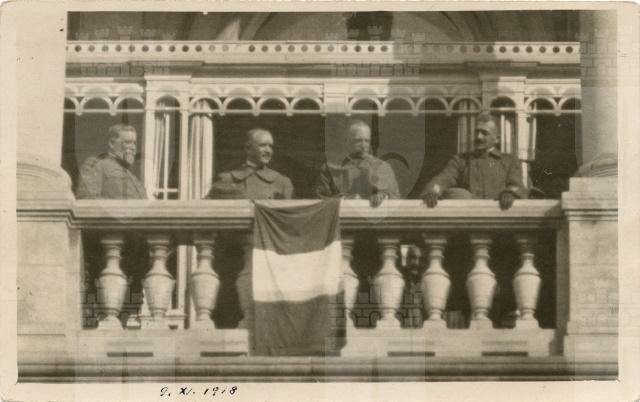
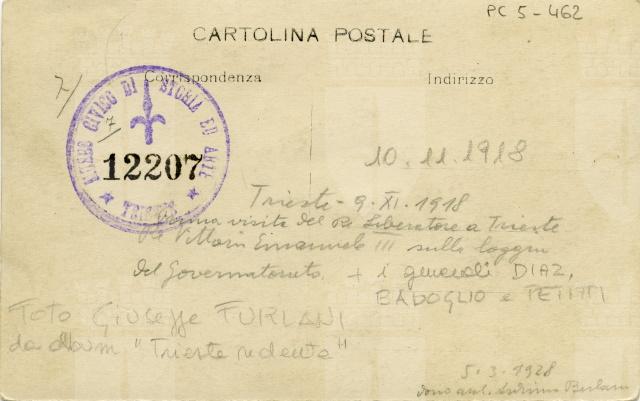
Note: The photograph was donated to the city of Trieste by architect Arduino Berlam on 5 March 1928. The architects Berlam — Ruggero and his son Arduino — were the designers of the synagogue in Trieste; ironically, on that same Piazza Grande, by then already Piazza Unità, Benito Mussolini would, a few years later, announce the racial laws.
Gregorian calendars, Julian calendars, and a habit of Giorgio
This long digression serves to indicate that we do not really know when the King visited Trieste: it was probably 9, 10, or 11 November (the latter being the King’s birthday, which may explain why Galli noted 11 November in order to associate the royal celebration with this historical event). The visit of Giorgio to Galli should have taken place between 4 and 10 November, and Giorgio told Galli that his father was already dead, placing the date of death on 1 November.
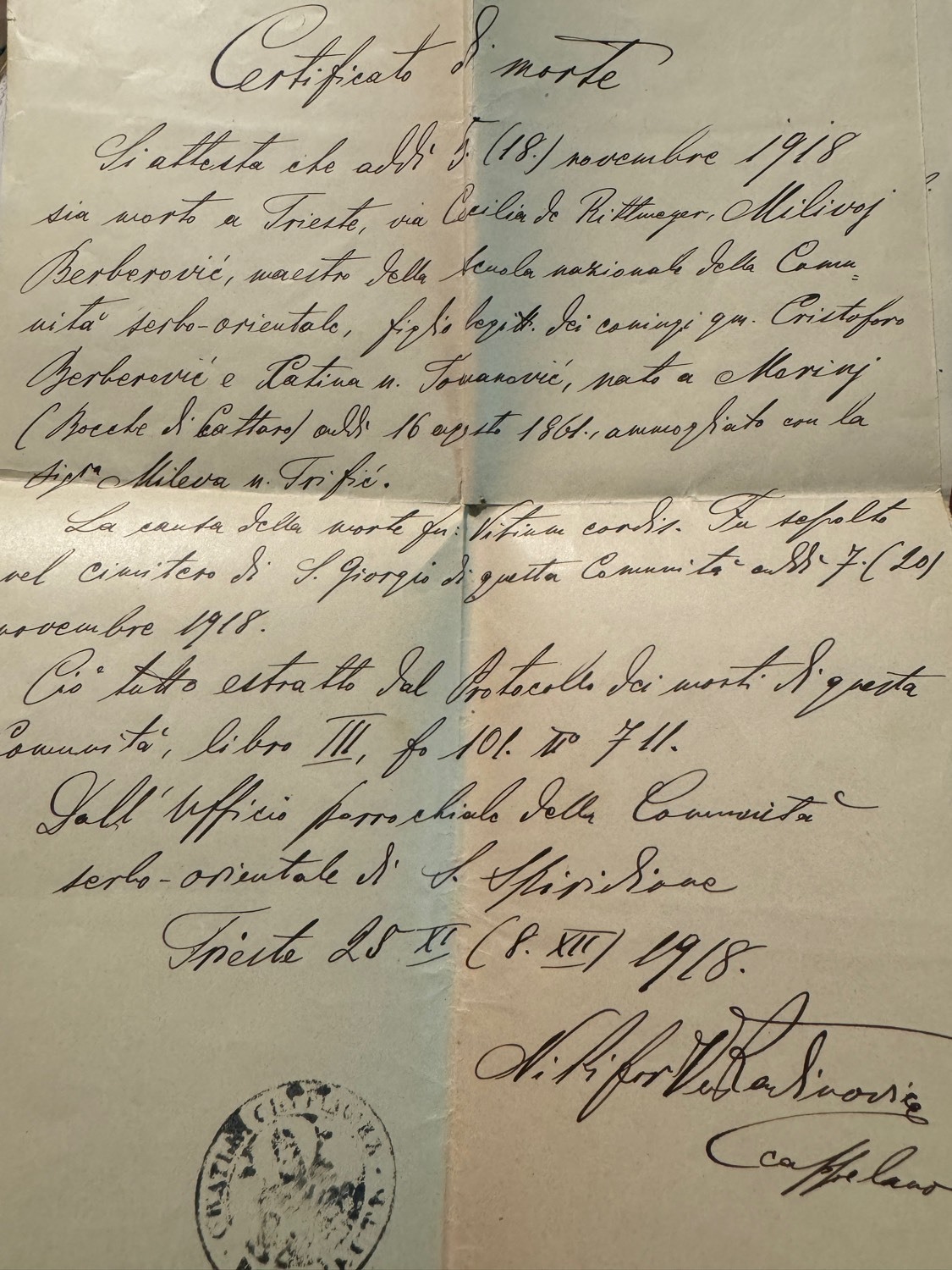
However, the death certificate of Milivoj Berberović indicates the date of death as 5 (18) November 1918, where “5” is the date according to the Julian calendar followed by the Orthodox Church, and “18” is the date according to the Gregorian calendar (followed by the Kingdom of Italy and used today in the Western world). The same certificate indicates that Milivoj was buried on 7 (20) November 1918.
So, when Giorgio visited Galli and told him that his father Milivoj was already dead, this was not accurate. Milivoj was probably very ill — family oral tradition says that he died of the Spanish flu — and most likely his days were counted. Yet Giorgio Berberović did bend reality, which, as we will learn, was a specific trait of his character, extensively documented throughout his entire life.
Sources: RAI Radiotelevisione Italiana, Collezione Gianni Bisiach, 4 novembre 1918 - Vittoria, il Re a Trieste, broadcast date: 04/11/2009, archived on the Portale storico della Presidenza della Repubblica. Carlo Galli, Diarii e Lettere, Tripoli 1911 - Trieste 1918 Casa editrice Sansoni (1951). La Porta Orientale, September–December 1938, Anno VIII, Fasc. 9–12. Archivio Università di Trieste. Fototeca dei Civici Musei di Storia ed Arte di Trieste, Fondo Arduino Berlam, Furlani Giuseppe, Trieste redenta : 1918-1919 : 12 fotografie, Trieste : Ed. dell'Ist. fot. triestino, 1919 post.
Serbia and Serbs in Trieste, 1914-1918
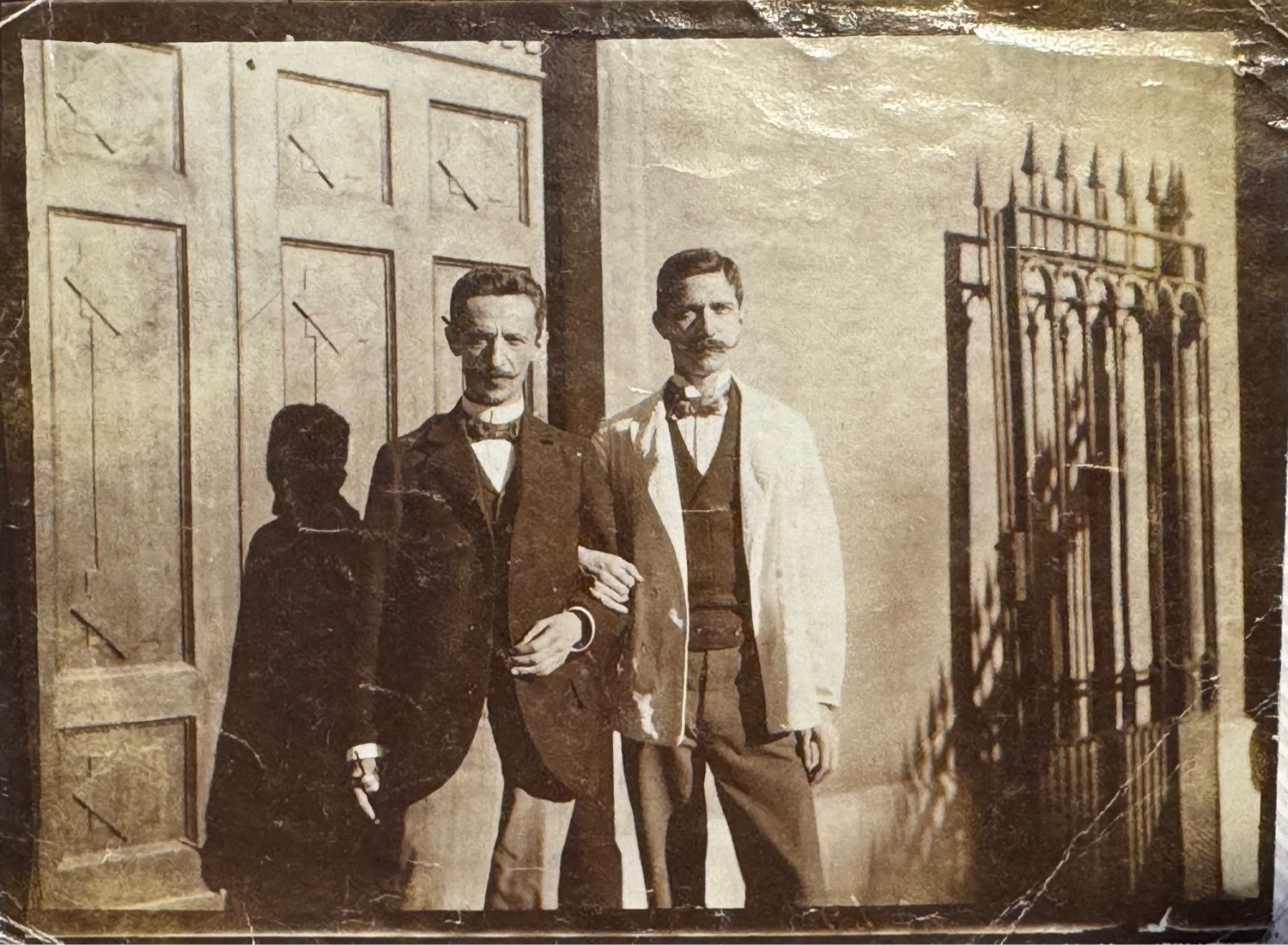
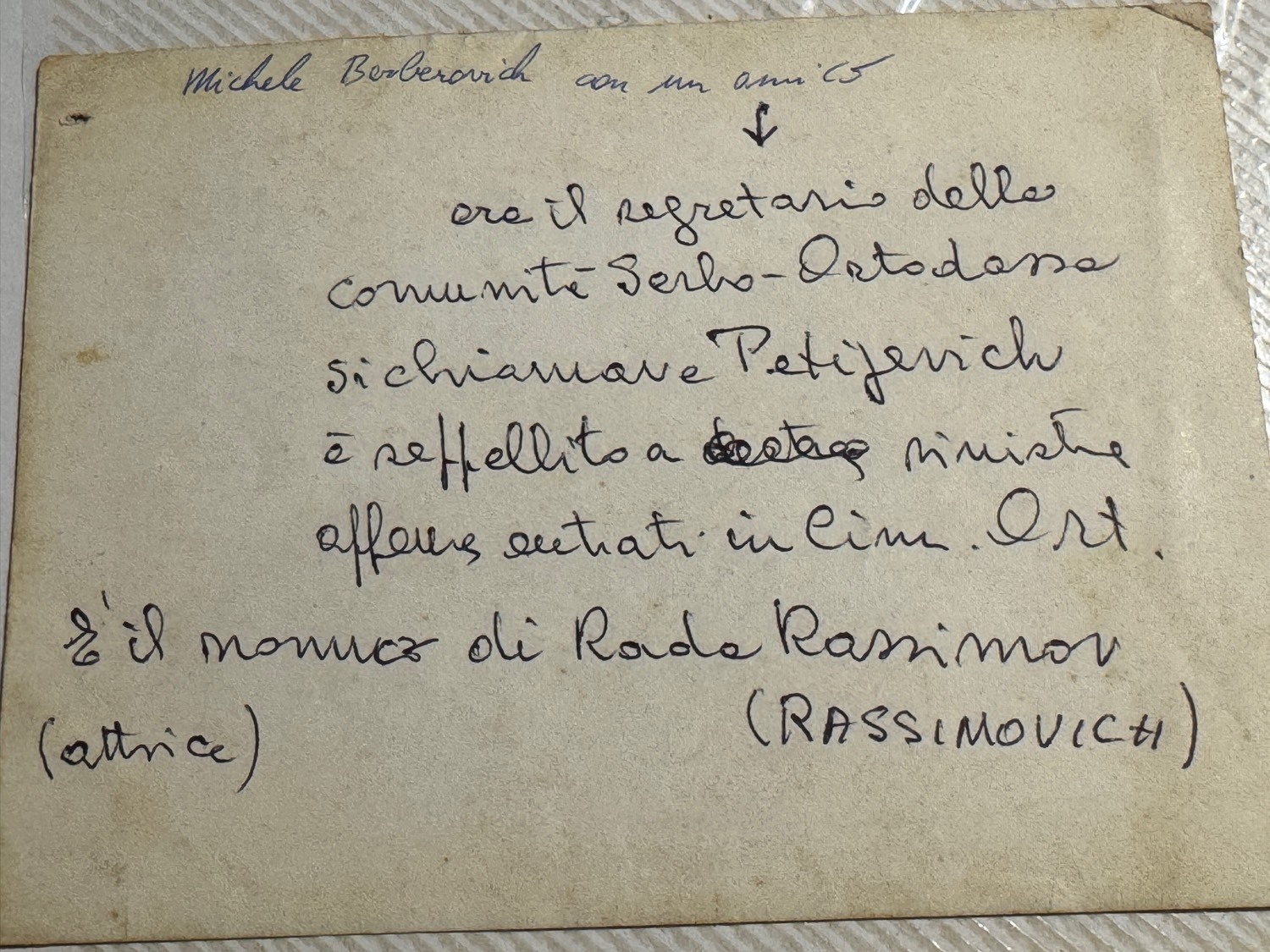
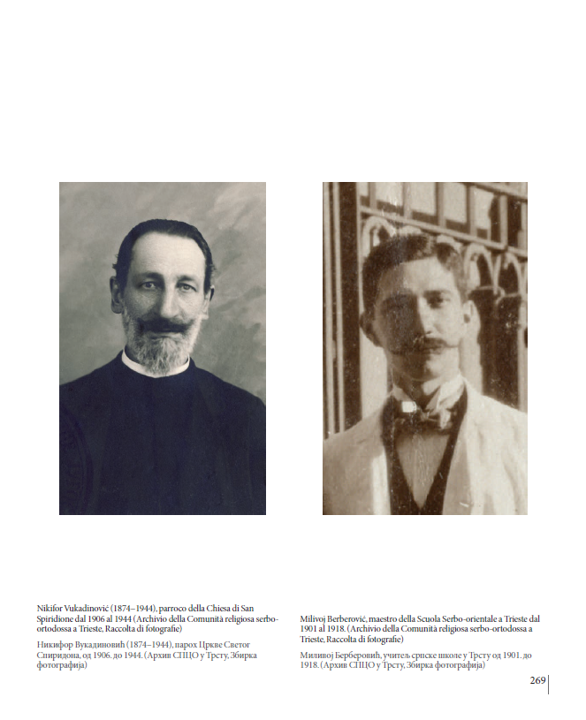
A photo of Milivoj appears in the book "La Serbia e i serbi 1914-1918" (СРБИЈА И СРБИ 1914–1918.)" by authors Miroslav Perišić and Jelica Reljić, published by the Comunità Religiosa Serbo-Ortodossa di Trieste (2017). References to Milivoj appears on pages pages 268 and 269 of the volume.
The caption says "Milivoj Berberović, maestro della Scuola Serbo-orientale a Trieste dal 1901 al 1918. (Archivio della Comunità religiosa serbo-ortodossa a Trieste, Raccolta di fotografie)". The text is also written in Serbian: "Миливој Берберовић, учитељ српске школе у Трсту од 1901. до 1918. (Архив СПЦО у Трсту, Збирка фотографија)".
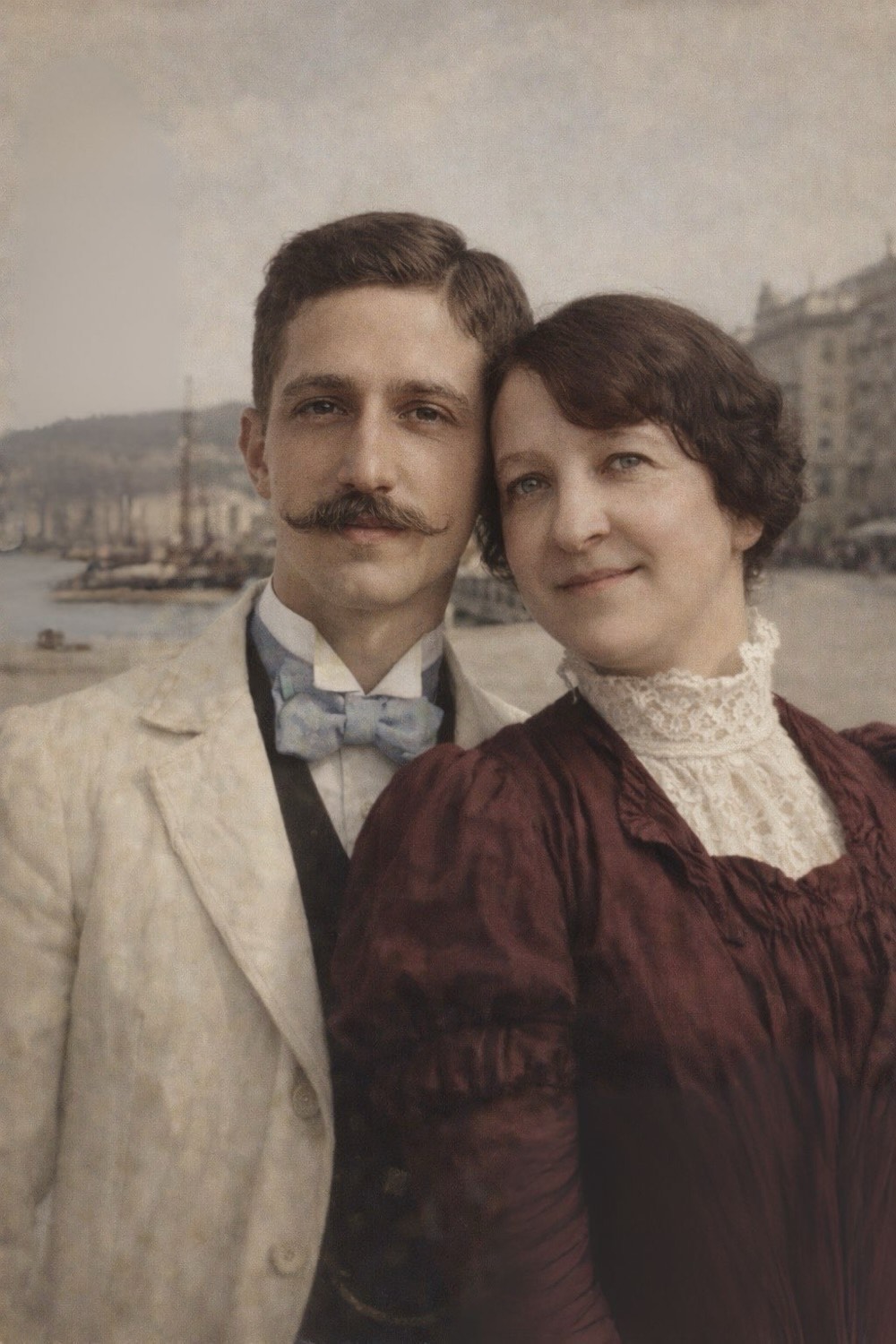
AI-based visual reconstruction
The family archives do not contain any photograph of Milivoj Berberović together with his wife Mileva Trifić. This image was therefore reconstructed using an AI tool, starting from original photographs of Milivoj and Mileva. While their individual portraits are faithful to the original sources, the pose and the location are fictional.
© 2025 - 2026 Riccardo Bevilacqua. All original text, structure, and commentary on this page are the intellectual property of the author, unless otherwise stated. Historical sources, quotations, images, and documents explicitly cited are used according to their original publication status and may be in the public domain or subject to their respective copyrights.